

You have not lost them. They are just becoming someone new.
And they need you more than they will ever admit.
The middle school years represent the most significant neurological restructuring since early childhood.
The adolescent brain undergoes a process called synaptic pruning, where neural connections that are not used regularly are eliminated and those that are used consistently are strengthened.
At the same time, the limbic system, which drives emotions, social awareness, and risk-taking, becomes significantly more active while the prefrontal cortex, which handles judgment, impulse control, and long-term thinking, is still a decade away from full development.
This is why your twelve year old can be brilliantly insightful one moment and make an incomprehensible decision the next.
The emotional intensity, the social hypersensitivity, the need for peer approval, the moodiness that seems to come from nowhere, all of it is the predictable output of a brain in profound transition.
Understanding this does not make it easier to live with.
But it changes how you respond to it, and that changes everything.

Middle school parenting is one of the loneliest seasons in the whole parenting arc.
Your child is going through the most turbulent developmental period of their life and they are doing it by pushing the people who love them most to the edges of their world.
You are trying to stay present for someone who seems to actively not want you there, while also watching them navigate social dynamics, academic pressure, identity questions, and a digital world that did not exist when you were their age.
The grief of this transition is real.
The fear is real.
And the love underneath all of it is more important now than it has ever been, even when it feels the least welcome.
You showing up consistently is the most important thing you can do, even when they pretend not to notice.
BEGIN HERE, FOR FREE
The 5-Minute Reset
Your free audio guide to the most chaotic 20 minutes of your parenting day.
The 5-Minute Reset is a free audio guide from Dr. Erica that helps you regulate your own nervous system so you can show up for your middle schooler without reactivity, without desperation, and without the kind of pressure that pushes them further away. Because staying connected to a teenager starts with staying regulated yourself.
Free. Five minutes. No login required.
Why your middle schooler's emotions seem completely out of proportion
What synaptic pruning means and why it explains everything about thirteen
How to talk to a teenager who will not talk back
Why your child suddenly cares more about their friends than about you
What to do when your middle schooler says they hate you
The social cruelty of middle school and how to help your child survive it
How to handle a teenager who lies
Why staying calm is the most powerful parenting tool you have right now
What anxiety looks like in middle school and when to get help
How to talk about phones and social media without it becoming a war
Why your middle schooler eats nothing for dinner and then wants food at ten pm
How to stay connected when they do not want to spend time with you
What your child needs to hear from you even when they seem not to care
The power of the side door conversation
How to handle a middle schooler who is struggling academically
What to do when your child is being bullied or is the one doing the bullying
How to talk about bodies, relationships, and sex without it being terrible
Why your middle schooler is harder on you than on anyone else
When to worry and when to wait with middle school behavior
How to keep the door open even after a big fight
No articles found for that search. Try a different word.
Four minutes. One thing you can try tonight.
Watch all Playful Patter videos on YouTube Link: youtube.com/@becomingplayful
These are organizations, books, and communities that Dr. Erica trusts and recommends for parents of middle schoolers.
Child Mind Institute
Deeply researched, compassionate articles on teen anxiety, depression, social challenges, and mental health. One of the most reliable resources for parents with serious concerns.
childmind.orgCommon Sense Media
Research-backed guidance on social media, phones, gaming, and online safety for the twelve to fourteen age group.
commonsensemedia.orgThe Teenage Brain (Dr. Frances Jensen)
A neuroscientist and mother explains the adolescent brain in a way that is both scientifically rigorous and deeply humanizing for parents.
Available at most librariesUntangled (Dr. Lisa Damour)
A clinical psychologist's guide to the seven developmental transitions of adolescent girls. Widely considered the best book available for parents of middle school age daughters.
Available at most librariesBrainstorm (Dr. Daniel Siegel)
A research-based exploration of the adolescent brain and why this turbulent time is also one of the most important and creative periods of human development.
Available at most librariesCrisis Text Line
Free, confidential crisis support via text for young people in distress. Available 24 hours a day, 7 days a week.
crisistextline.org Call: Text HOME to 741741NAMI
Resources and support for parents concerned about their middle schooler's mental health, including a helpline, local support groups, and guides for navigating the school system.
nami.orgRaising Good Humans
A podcast and community for parents raising emotionally healthy children. Particularly useful for parents navigating the middle school transition.
raisinggoodhumans.comPACER Center Bullying Prevention
Research-based tools for parents dealing with bullying at the middle school level, including how to document incidents and work with schools.
pacer.org/bullyingCenter for Parent and Teen Communication
Research-based articles and guides specifically designed to help parents build stronger relationships with their middle and high school age children.
parentandteen.comAnxiety and Depression Association of America
Resources for parents whose middle schoolers are showing signs of anxiety or depression, with guidance on when and how to seek professional support.
adaa.orgPFLAG
A welcoming resource for parents of children who may be questioning their gender identity or sexual orientation, offering community, education, and advocacy support.
pflag.orgPractical tools for parents of middle schoolers
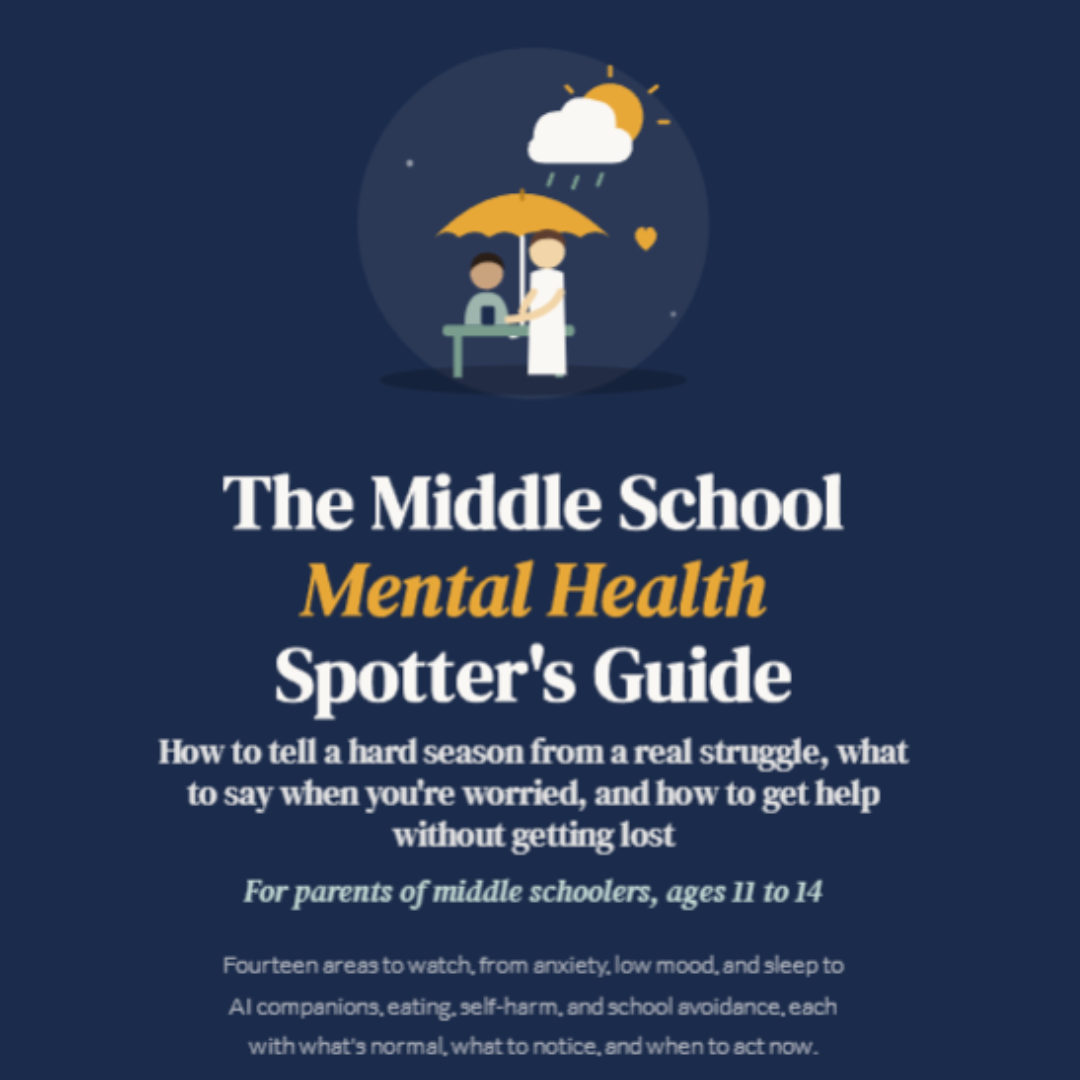
$27 · For parents of middle schoolers, ages 11 to 14 · 44-page PDF, instant download
Tell a hard season from a real struggle, and know what to do either way.
Middle school is supposed to be moody. It's also when many mental health concerns first appear. This guide gives you a clear, calm way to tell the difference, the words to use when you're worried, and a map for getting help without getting lost in the system.
What's inside
A simple "Is it a phase?" check and a four-step way to respond
14 areas to watch, from anxiety, sleep, and screens to AI companions, eating, and self-harm
What's normal, what to keep an eye on, and when to act right away
How to find care, and what to do while you wait
A two-week tracker, an appointment prep sheet, and a family safety plan
This is for you if
You keep wondering, "Is this just middle school, or something more?"
You want to know what to say if you're worried about your child
You'd like a plan for getting help before you need it
Note: This is an educational guide, not a diagnostic tool, and it includes crisis resources such as 988.
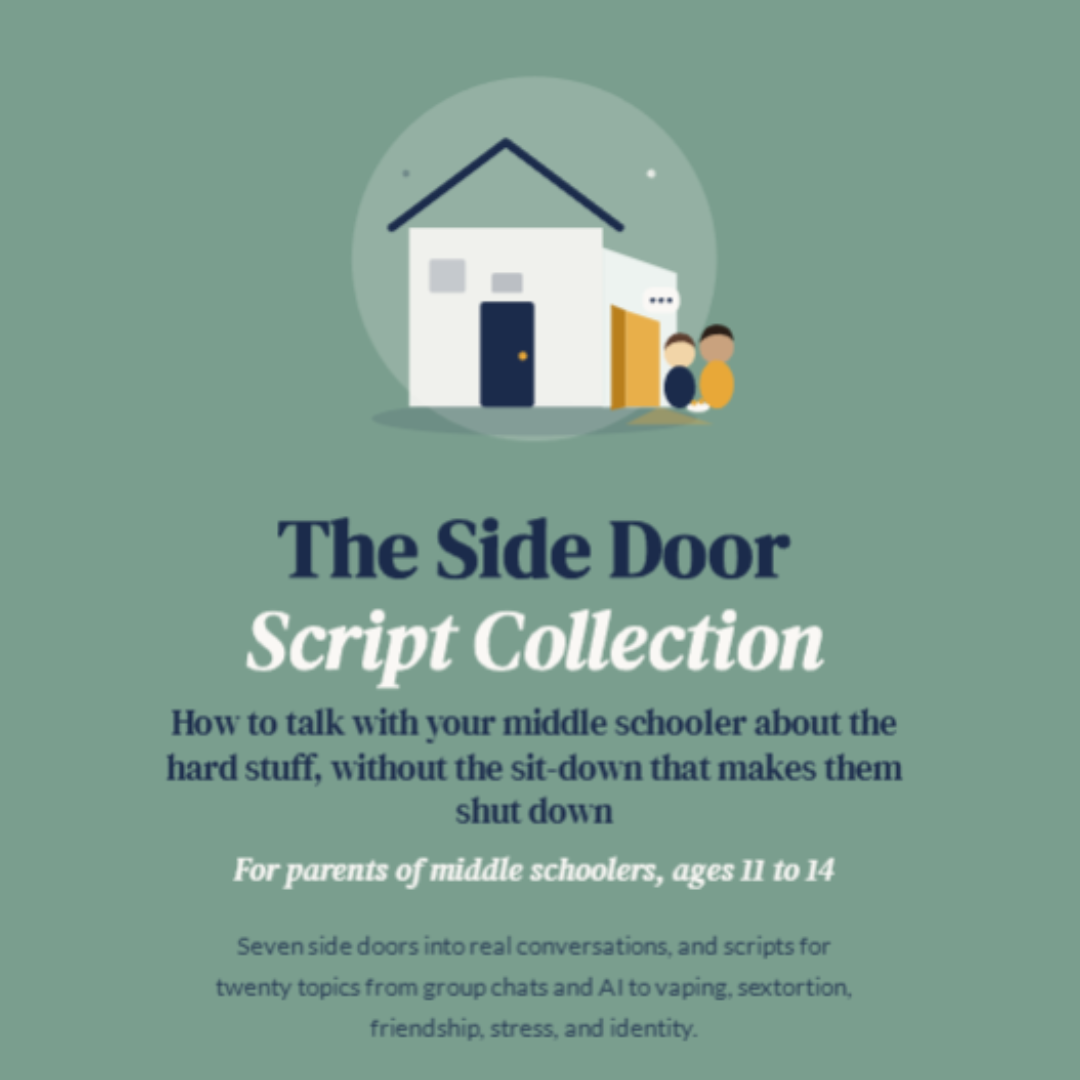
$17 · For parents of middle schoolers, ages 11 to 14 · 34-page PDF, instant download
Talk about the hard stuff without the sit-down that makes them shut down.
"Can we talk?" is often the fastest way to end a conversation with a middle schooler. This collection shows you seven side doors, like the car ride, the late-night snack, and the what-if question, that make hard topics feel low-pressure enough to walk through.
What's inside
Seven side doors into real conversations
Scripts for 20 topics, including group chats, AI chatbots, vaping, sextortion, friendship, stress, and identity
What to skip, what to try, and what to say if they open up
Key facts and red flags for each topic
A family safety plan and cut-out question cards for the car
This is for you if
Your middle schooler shuts down when you try to talk
You know you need to discuss tough topics but don't know how to start
You want to be the person they come to when something goes wrong
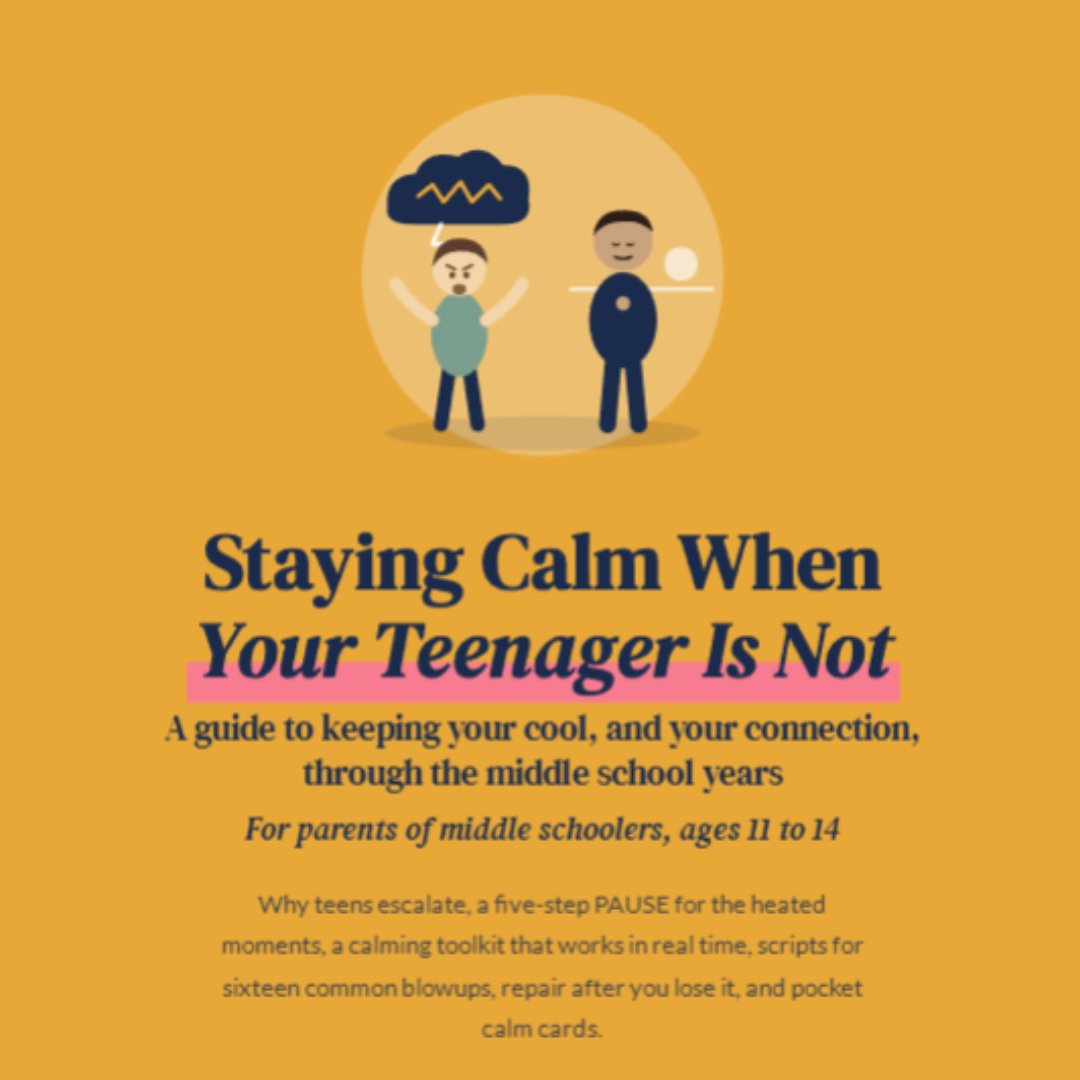
$17 · For parents of middle schoolers, ages 11 to 14 · 33-page PDF, instant download
Keep your cool, and your connection, through the middle school years.
Eye rolls, slammed doors, and words that cut deep can send any parent's temper climbing. This guide helps you understand why young teens escalate and gives you a simple way to stay steady, so a heated moment doesn't become a broken one.
What's inside
Why young teens escalate, and the hidden fuel behind blowups
A five-step PAUSE for heated moments
A real-time calming toolkit that works on your body first
Scripts for sixteen common blowups
How to repair after you lose it, plus pocket calm cards
This is for you if
Small disagreements with your teen often turn into big ones
You've said things in anger you wish you could take back
You want to be the calm in your teen's storm