

They still need you. They just need you differently than they used to.
And nobody told you how to do this part.
The nine to eleven age range is one of the most neurologically significant and least talked about developmental windows in childhood.
The brain is preparing for the hormonal and structural changes of adolescence, which means your child is beginning to process the world more independently, question authority more readily, and care deeply about peer relationships in a way that can feel like a direct replacement of you.
This is not rejection.
It is differentiation, the healthy developmental process by which children begin to establish a separate identity while still needing the secure base of their relationship with you.
Research consistently shows that children who feel genuinely connected to their parents during this window, not controlled, not smothered, but connected, are significantly more likely to navigate adolescence with resilience and emotional health.
The connection you build right now is the bridge that carries them through what is coming next.

Parenting a nine to eleven year old in 2026 comes with a particular kind of uncertainty that is hard to name.
They are not little anymore but they are not teenagers yet.
They roll their eyes but still want you at bedtime.
They have strong opinions about everything but still fall apart when something goes wrong at school.
They are growing into themselves at a pace that can feel both too fast and not fast enough depending on the day.
And you are trying to stay close to someone who is actively, healthily, appropriately moving slightly further away.
That is one of the more nuanced things parenting asks of you.
It deserves to be acknowledged.
BEGIN HERE, FOR FREE
The 5-Minute Reset
Your free audio guide to the most chaotic 20 minutes of your parenting day.
The 5-Minute Reset is a free audio guide from Dr. Erica designed to help you regulate your own nervous system so you can show up for your child in the way they actually need right now. Because staying connected to a child who is learning to be more independent starts with you feeling steady enough to let them.
Free. Five minutes. No login required.
Why your child is pulling away and why that is actually healthy
The friendship world of nine to eleven year olds and how to navigate it with them
What to do when your child says you are embarrassing
How to have conversations with a child who does not want to talk
Why your ten year old suddenly has very strong opinions about everything
How to stay in their world when they are trying to leave yours
What peer pressure actually looks like at this age
Why your child is more emotional than you expected at ten
How to handle a child who is starting to talk back
The difference between privacy and secrecy at this age
How to build your child's confidence before middle school
What anxiety looks like in nine to eleven year olds
Side by side connection is the secret to staying close
How to talk about bodies and puberty before it starts
Screen time and social media at this age and what the research says
When siblings are at completely different developmental stages
How to handle a child who says they do not care about school anymore
What your child needs from you that they cannot ask for
The one question that opens every conversation at this age
How to repair the relationship after a big conflict
No articles found for that search. Try a different word.
Four minutes. One thing you can try tonight.
Watch all Playful Patter videos on YouTube Link: youtube.com/@becomingplayful
These are organizations, books, and communities that Dr. Erica trusts and recommends for parents of children ages nine to eleven.
Child Mind Institute
Expert, compassionate articles on anxiety, ADHD, social challenges, and emotional health in school-age children. One of the most reliable sources for parents with concerns.
childmind.orgUnderstood.org
A comprehensive resource for parents of children with learning and thinking differences. Particularly useful as academic demands increase in upper elementary.
understood.orgCommon Sense Media
Trusted, research-backed guidance on screen time, social media, apps, and games for the nine to eleven age group.
commonsensemedia.orgThe Awkward Phase (Dr. Cara Natterson)
A warm, science-backed guide to puberty and the tween years for both parents and children, covering the physical and emotional changes starting at this age.
caranatterson.comRaising Good Humans
A podcast and community for parents raising emotionally intelligent children. Consistently useful for the nuanced challenges of the upper elementary years.
raisinggoodhumans.comBig Life Journal (Tween Edition)
Growth mindset tools and conversation starters designed specifically for the nine to twelve age group. Bridges the gap between childhood and adolescence beautifully.
biglifejournal.comAmerican Psychological Association
Accessible, research-backed articles on child development, anxiety, and social-emotional health for parents who want to go deeper into the science.
apa.org/topics/childrenAnxiety and Depression Association of America
Resources for parents whose children are showing signs of anxiety as social and academic pressure increases in upper elementary.
adaa.orgThe Whole Brain Child
A practical guide to understanding your child's developing brain and why they do what they do. Applies directly to the nine to eleven developmental window.
Available at most librariesBoys and Girls Clubs of America
A trusted community resource for children ages six to eighteen offering after-school programs, mentorship, and social connection opportunities.
bgca.orgPACER Center Bullying Prevention
Research-based resources for parents concerned about bullying at this age, including how to talk to your child and when to involve the school.
pacer.org/bullyingHealthyChildren.org
Pediatrician-approved guidance on the social, emotional, and physical changes of the tween years, written for parents in plain language.
healthychildren.orgPractical tools for parents of upper elementary children.
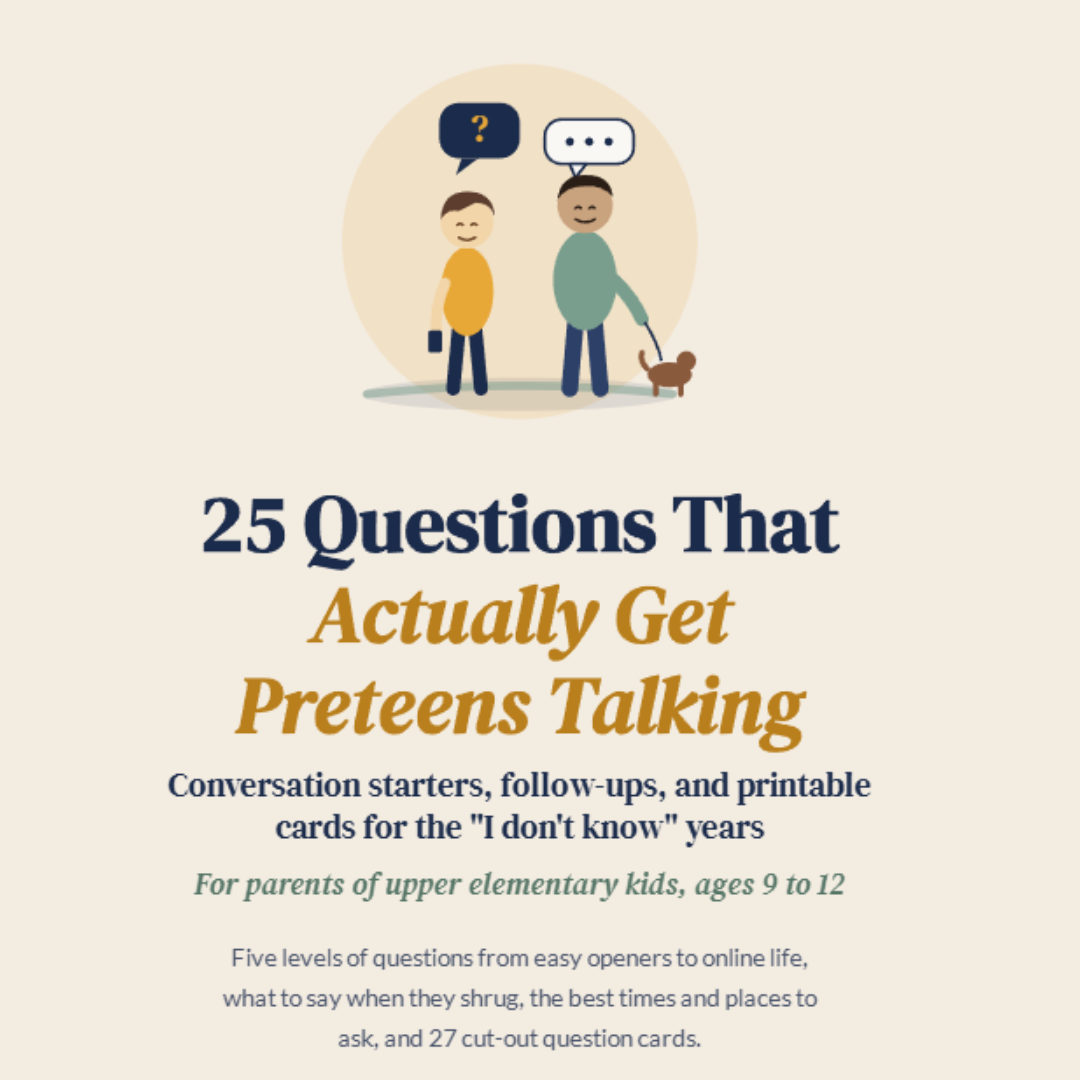
$10 · For parents of kids ages 9 to 12 · 29-page PDF, instant download
For the "I don't know" years, when a shrug is the whole answer.
Preteens still want to talk. They just need a better way in. These 25 questions move from easy openers to deeper topics, with follow-ups for when you get a shrug and ideas for the times and places kids open up most.
What's inside
25 questions across five levels, from light to meaningful
Questions about online life, friends, and feelings
What to say when they shrug or say "I don't know"
The best times and places to ask
27 cut-out question cards for the car or dinner table
This is for you if
Conversations with your preteen have started to feel one-word short
You want to know what's really going on in their world
You're looking for easy, low-pressure ways to connect

$17 · For parents of kids ages 9 to 12 · 35-page PDF, instant download
The many small talks that matter more than "The Talk."
Puberty is easier for kids when it's an ongoing conversation instead of one awkward sit-down. This pack gives you calm, clear, age-appropriate words for bodies, feelings, and the online world, so your child knows they can come to you with anything.
What's inside
22 conversation starters on bodies, feelings, and online life
Honest answers to the questions kids actually ask
Guidance by age, so you know what to share and when
Tips for staying calm when the questions surprise you
Printables your child can use on their own, including anonymous question slips
This is for you if
You're not sure how, or when, to start talking about puberty
You want your child to hear accurate information from you first
You'd like conversations to feel natural instead of awkward
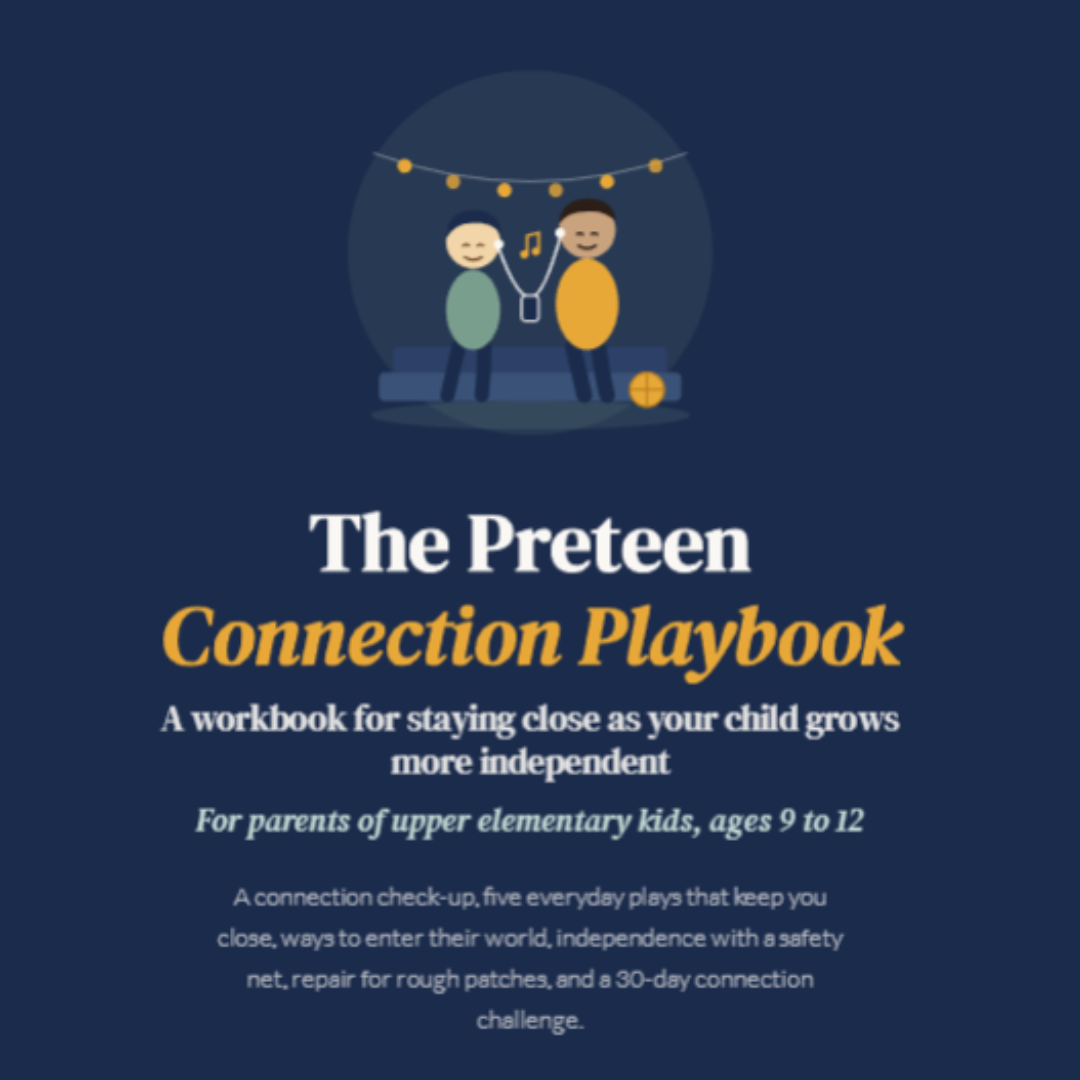
$27 · For parents of kids ages 9 to 12 · 25-page PDF workbook, instant download
Stay close as your child grows more independent.
The preteen years can bring more closed doors and fewer hugs. This workbook helps you stay connected while giving your child room to grow, with everyday plays that fit into real, busy family life.
What's inside
A connection check-up to see where you are now
Five everyday plays that keep you close
Ways to enter their world of games, shows, and interests
Independence with a safety net, and repair for rough patches
A 30-day connection challenge calendar and a connection menu
This is for you if
You feel your preteen pulling away and want to stay close
You want to support their independence without losing connection
You'd like simple ideas that work with a busy schedule